The Jožef Stefan Institute, as the lead partner, has secured the SMARTFACT programme, bringing together 17 research and industrial partners to develop more efficient, flexible and sustainable manufacturing. Research teams, system integrators and end users will jointly develop and validate solutions in real industrial environments. The programme comprises four thematic pillars: AI-supported process control, robotics of the future, laser processing for electronics, and plasma technologies. Activities will progress from industrial research at TRL 3–4 to prototype development and demonstrations at TRL 5–6. Expected results include self-learning manufacturing monitoring, energy-efficient production scheduling, automated quality inspection using computer vision, adaptable robotic systems, advanced laser processing and thermochromic sensors. SMARTFACT will contribute to higher productivity, improved quality, greater energy efficiency and the competitiveness of Slovenian industry. |
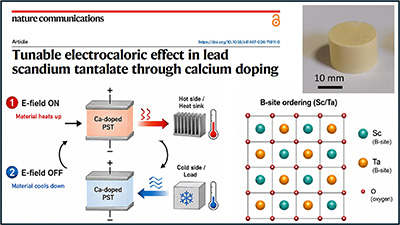
Researchers from the Electronic Ceramics Department at the Jožef Stefan Institute Ivana Goričan, Nejc Suban, Silvo Drnovšek, Matej Šadl and Hana Uršič, together with colleagues from Luxembourg and France, have published an article in Nature Communications Tunable electrocaloric effect in lead scandium tantalate through calcium doping. The study shows that calcium doping of lead scandium tantalate with a highly ordered B-site cation arrangement in the perovskite structure enables precise tuning of its phase transitions and electrocaloric response. The results reveal the emergence of an intermediate antiferroelectric phase and demonstrate an electrocaloric temperature change of about 2 K over a broad temperature range from 263 K to 353 K. These findings open new possibilities for cascaded electrocaloric cooling devices with extended operating ranges, including below the freezing point of water. |

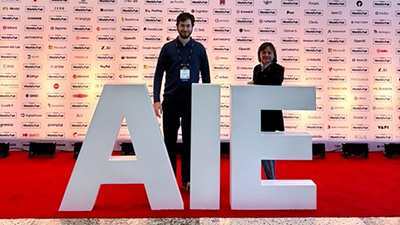
Dr. Blaž Bertalanič and Dr. Carolina Fortuna of the Department of Communication Systems were awarded an Industry Spotlight at the AI Engineer World's Fair conference and invited for presentation at the AI Engineer World's Fair in San Francisco with more than 6,000 developers from every frontier AI lab. Their finding cuts against how multi-agent systems are being built today. Multi-agent LLM systems, i.e. teams of AI agents that debate and vote on answers, are widely deployed on the assumption that more agents means more capability. Dr. Bertalanič and Dr. Fortuna have shown quantitatively that this assumption often fails: agent teams show sharply diminishing returns as they scale. Their study found that unguided debate among identical agents frequently underperforms simple isolated self-correction, burning 2–3 times more computation for equal or lower accuracy—undermined by agents conforming to the majority, abandoning correct reasoning under peer pressure, and by voting that discards correct answers already generated. The finding points to architectural diversity, not sheer agent count, as the key lever for scaling multi-agent AI systems in production. |
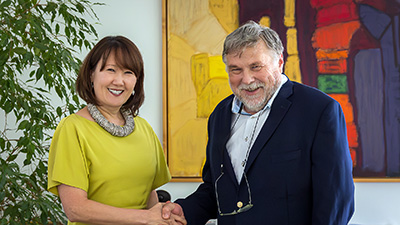
On July 15, 2026, the new U.S. Ambassador to Slovenia, Her Excellency Asel K. Roberts, visited the Jožef Stefan Institute. The director of the Jožef Stefan Institute, Prof. Dr. Leon Cizelj, began by introducing her to Slovenia’s largest scientific and research institution, which undoubtedly offers excellent opportunities for cooperation with the United States in various fields. “The fields of artificial intelligence, the TRIGA reactor and nuclear technologies, quantum technologies and superconductivity, as well as projects related to the CERN and ITER accelerators, are at the forefront of the Jožef Stefan Institute’s work. We are already collaborating with the U.S., and during today’s visit, we explored possibilities for even better expanding this cooperation and collaboration with Ambassador Roberts,” said the Institute’s director, Prof. Dr. Leon Cizelj. Most of the JSI’s formal international ties are linked to the European Research Area; cooperation with the U.S. takes place primarily through joint research projects, scientific publications, researcher exchanges, and participation in major international research infrastructures. Both Cizelj and Roberts shared their hope for continued broad cooperation. |